
Fast paced technological advances have made it imperative to develop individual and organizational capacities through continuous learning .and training for survival, efficiency and growth in the national and international arena.
These were the comments by Professor Dr. Zakria Hussain, chairperson, vice-chancellor of the Government College University (GCU), Faisalabad and National project director, Promoting Employment and Productivity in Garment Industry (PEPGI) project, at the inaugural ceremony of training of trainers on "Apparel manufacturing and management".
The event was organized by PEPGI project, at Pakistan Readymade Garments Technical Training Institute (PRGTTT), Lahore.
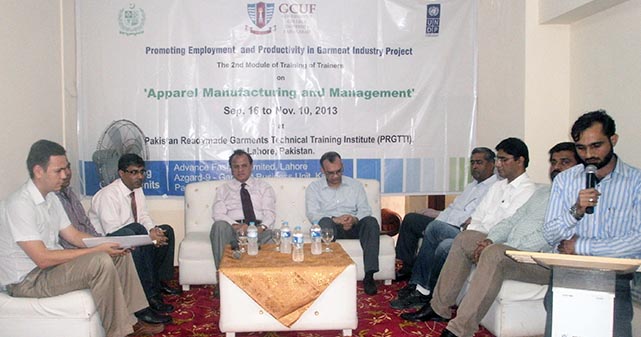 "Unfortunately, we have not been able to fully exploit the prospects of remarkable potential growth in the garment industry, where value addition to cotton can perform wonders," he said.
"PEPGI is a beacon light for improving productivity in the garment industry the backbone of Pakistan's industrial sector which has shown resilience despite overwhelming challenges."
"We are thankful to the United Nations Development Program (UNDP) for supporting sustainable initiatives such as PEPGI project, which has helped improve Uves. The GCU, Faisalabad is committed to provide the best services and delivery in the garment sector through effective implementation of PEPGI project," Hussain said.
Hassan Nasir Jami, regional director of the National Vocational and Technical Training Commission (NAVTTC), Punjab, was the chief guest on the occasion.
Sudhat Geegana, consultant Technopak, delivered presentation on the overview of garment industry in Pakistan and elaborated the training schedule and module.
"The most attractive feature of the PEPGI project is where the foreign consultants conduct a performance gap analysis and offer consulting guidelines to bridge the gaps identified at gap analysis stage," he said.
"Unfortunately, we have not been able to fully exploit the prospects of remarkable potential growth in the garment industry, where value addition to cotton can perform wonders," he said.
"PEPGI is a beacon light for improving productivity in the garment industry the backbone of Pakistan's industrial sector which has shown resilience despite overwhelming challenges."
"We are thankful to the United Nations Development Program (UNDP) for supporting sustainable initiatives such as PEPGI project, which has helped improve Uves. The GCU, Faisalabad is committed to provide the best services and delivery in the garment sector through effective implementation of PEPGI project," Hussain said.
Hassan Nasir Jami, regional director of the National Vocational and Technical Training Commission (NAVTTC), Punjab, was the chief guest on the occasion.
Sudhat Geegana, consultant Technopak, delivered presentation on the overview of garment industry in Pakistan and elaborated the training schedule and module.
"The most attractive feature of the PEPGI project is where the foreign consultants conduct a performance gap analysis and offer consulting guidelines to bridge the gaps identified at gap analysis stage," he said.
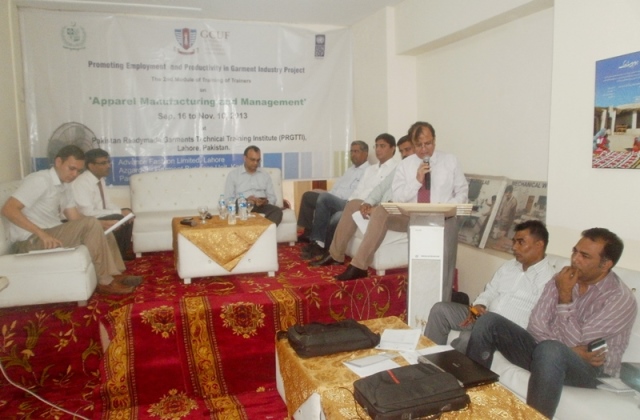 Shujaat Mirza, director of Advance Fashion Limited, elaborating experiences from the garment industry, said: "Now it is time to organise this business on more professional lines and employing latest techniques in garment sewing and laundry business."
"In this context, training and development of human resource is one of the most critical areas of garment business. I hope PPEPGI would continue and expand this program for the benefit of the garment industry. I would appeal to colleagues in the industry to utilize this excellent opportunity to upgrade their businesses."
Habib Abbasi, general manager operations, Azgard-9, highlighted the importance of training, and said: "We shall focus on adding value to our human resource in the garment industry, as it is a prerequisite for success. We strongly believe in training, as it empowers us to achieve targets by acquiring skills. These 45 days of training can change your life. You can subsequently change Uves of 45,000 people."
Shujaat Mirza, director of Advance Fashion Limited, elaborating experiences from the garment industry, said: "Now it is time to organise this business on more professional lines and employing latest techniques in garment sewing and laundry business."
"In this context, training and development of human resource is one of the most critical areas of garment business. I hope PPEPGI would continue and expand this program for the benefit of the garment industry. I would appeal to colleagues in the industry to utilize this excellent opportunity to upgrade their businesses."
Habib Abbasi, general manager operations, Azgard-9, highlighted the importance of training, and said: "We shall focus on adding value to our human resource in the garment industry, as it is a prerequisite for success. We strongly believe in training, as it empowers us to achieve targets by acquiring skills. These 45 days of training can change your life. You can subsequently change Uves of 45,000 people."
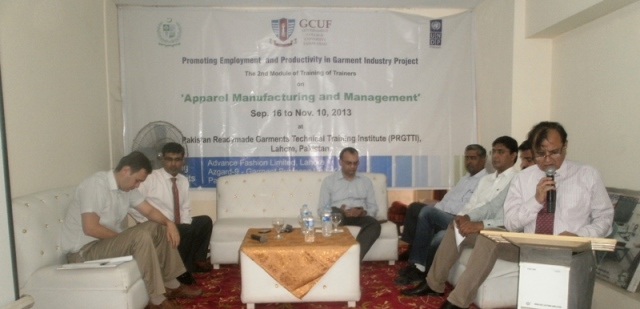 Dilating upon the PEPGI background, the National Project Manager, PEPGI Project, Punjab, Shoeb Iqbal Syed, said that the project, an initiative of the UNDP, aims at working with the garment industry of Pakistan to achieve two development results: creating employment opportunities for youth and women, besides enhancing labor productivity on floor efficiency in the garment industry; and developing capacities of local consultancy / training service providers to train workers and middle management in the garment value chain.